


Incorrect build vs. buy decisions underpin 67% of failed software implementations (AppScrip).
Building a rich text editor (RTE) yourself from open source components seems like a good, cost-effective compromise. But the impacts to team velocity, long-term budget drains, and maintenance costs can affect engineering capacity for years. Navigating real trade-offs between assembling your own editor stack and adopting an open source commercial editor is no easy task.
Comparative analysis: Using TinyMCE open source vs building with open source components
The choice between adopting TinyMCE and assembling your own editor from open source components is both strategic and technical. Both paths rely on open source foundations, but they differ fundamentally in where complexity lives and who owns the ongoing maintenance burden. And most apps are built on open source components, which currently form 79–100% of most codebases according to the 2025 Open Source Security and Risk Analysis Report.
Building with open source components means composing libraries like Slate, ProseMirror, or Lexical into a custom solution, and sourcing separate libraries for UI elements like toolbars, buttons, menus, and rich content rendering. TinyMCE provides an open source editor that is available in three distinct configurations:
- TinyMCE self-hosted is pure open source: free to use, no restrictions on non-commercial usage, and you manage your own hosting and updates.
- TinyMCE Cloud is available via a Free tier that includes 1,000 editor loads per month at no cost, with additional loads billed at $40 per 1,000. TinyMCE handles hosting for you.
- TinyMCE’s commercial tiers (paid) add advanced features, long-term support, security SLAs, and compliance certifications on top of the cloud delivery model. Commercial tiers can be self-hosted or on TinyMCE Cloud, depending on your needs.
Detailed feature comparison
TinyMCE open source offers a production-ready solution with a myriad of features, customizable themes, and framework integrations that deploy quickly, while composable open source libraries provide maximum flexibility at the cost of significant development effort.
Choose TinyMCE when you need reliable rich text editing without building infrastructure, or opt for composable libraries when your editing requirements differ fundamentally from standard rich text and justify the engineering investment.
|
TinyMCE |
Composable OSS Libraries |
|
|
Time to Deploy |
Hours (cloud): The TinyMCE cloud Free tier deploys in a few minutes. Configure a script tag and your toolbar, and you're up and running. |
Weeks: Start with primitives and build everything (toolbars, formatting, shortcuts, undo/redo) yourself. |
|
Extensibility |
High-level plugin APIs for features like toolbar buttons, dialogs, content handlers. |
Low-level control over rendering and transactions (e.g., ProseMirror) requires infrastructure maintenance. |
|
Performance |
Optimized for large documents, complex tables, mobile input, clipboard, collaboration, Word paste, collaborative undo. |
You own all performance optimization responsibilities. |
|
Framework Support |
Official native React, Angular, Vue, Blazor, jQuery, Svelte, and Web Component integrations. |
Primarily React-focused; Angular/Vue support varies or may not exist. |
Technical implementation considerations
There are two places where hidden costs primarily accumulate for RTE work when considering an out-of-the-box open source editor versus composable open source libraries.
Cross-browser rendering: Safari handles selection differently than Chrome, mobile browsers use different input models, and input method editor (IME) composition events work inconsistently. TinyMCE normalizes these differences and ships fixes when browsers regress. When you build your own RTE, browser vendors don't announce breaking changes, so you usually discover them through a drop in app usage or user bug reports. Then your team ends up spending more time fixing the airplane while you’re flying.
State management complexity: Managing all the active property states in an RTE goes from tracking formatting changes to cursor position to content edits, and even more. This multiplies when you’re connecting editor primitives to your application's state layer. Libraries like ProseMirror provide excellent foundations, but coordination mistakes surface as hard-to-reproduce bugs months later. Accessibility and internationalization represent ongoing compliance work. WCAG standards evolve, screen readers change, and supporting right-to-left languages requires vigilance.
Only 2% of organizations that built their own RTEs reported no problems, according to the State of Rich Text Editing 2025 report. The data from the majority reveals a consistent reality gap:
- 23% took longer than expected.
- 19% cost more than planned.
- 17% found it harder than expected.
These statistics are a predictable result of underestimating ownership of an intricate subsystem that has to handle cross-browser rendering and state management complexity. An RTE is more tangled than most teams realize.
Cost and resource modeling for open source WYSIWYG editors
The real cost questions that must be answered are: What happens after the purchase order or the initial commit? Where does engineering capacity go over the next three to five years?
Total cost of ownership (TCO) differences
Initial implementation costs are rarely the problem. The true challenge is sustained maintenance. Each bug, user need, or requirement could require someone on your team to recognize, prioritize, design a fix, implement it, test it across environments, and deploy it, depending on whether you’re building or buying.
When most teams compare TCO, they compare licensing costs against initial development estimates. But ownership cost accumulates over time. An editor built in a few months could require one engineer at 20% capacity indefinitely. That's engineering focus that could have gone to features that differentiate your product, and the opportunity cost becomes the real expense when the editor isn't how you want to win customers.
Over a 3–5 year timeframe after you’ve implemented the editor, the cost trajectory diverges:
- Building starts cheaper, but the curve slopes upward as technical debt accumulates: original engineers might leave, and the gap between your editor and new requirements widens.
- Adopting TinyMCE frontloads setup costs but flattens them over time, though the shape differs by deployment model.
- Self-hosted is free with no usage caps, but you retain responsibility for hosting, CDN delivery, and keeping the editor updated.
- TinyMCE Cloud offloads hosting and maintenance but introduces metered costs, so costs scale with traffic and should be modeled against your expected usage before you commit.
The industry signals on misjudged economics are stark: Organizations using structured evaluation frameworks to choose between building or buying report thirty to forty percent fewer implementation failures. Ultimately, the pattern is consistent: teams underestimate long-term ownership and overestimate the strategic value of building new infrastructure. Organizations that optimize the build-vs-buy decision achieve ~30% faster time-to-market and ~25% cost savings in software initiatives.
Adoption strategy
Transitioning from legacy editors or homegrown tools doesn't require ripping everything out at once. Most teams adopt incrementally, so new features get the new editor first, and legacy content stays in place until there's a reason to migrate it. This reduces risk and spreads implementation effort across quarters rather than concentrating it in a single disruptive sprint.
The choice between incremental rollout and full replacement depends on your content model and user workflows. If your editor instances are isolated (different content types, different user roles), incremental adoption is straightforward. If editing is deeply integrated across your application, a phased migration requires running two editors in parallel temporarily, which adds complexity but buys you validation time before committing fully.
The teams that migrate successfully treat it as a change management problem, not just an engineering problem.
Enterprise scalability assessment
Plugin ecosystems and bespoke extensions represent different ownership models. A plugin ecosystem means you're extending a maintained foundation, so when the core editor adapts, your extensions inherit those fixes.
Bespoke extensions to a custom-built editor mean you own the entire dependency chain. When a security vulnerability appears in an underlying library, your team is responsible for identifying it, evaluating the risk, patching it, and coordinating the update across your extension layer.
Security, compliance, and governance of open source software (OSS) dependencies become organizational challenges at scale.
- 96% of orgs reported increasing or maintaining use of OSS year-over-year. (Open Source Initiative)
- Roughly 16% of OSS projects may be abandoned without transition to new maintainers. (Guillerme Avelino)
When you build with multiple libraries, you're responsible for a lot:
- Tracking dependencies.
- Monitoring for vulnerabilities.
- Evaluating maintenance health of upstream projects.
- Having a plan when a critical library stops receiving updates.
- Ensuring the security of the RTE.
Commercial open source solutions like TinyMCE's commercial tier include security SLAs, formal patch processes, and compliance certifications, so you're handing over the governance burden. The self-hosted open source version benefits from the same core codebase and community patches, but without formal SLA commitments. Your team retains responsibility for tracking updates and coordinating security patches.
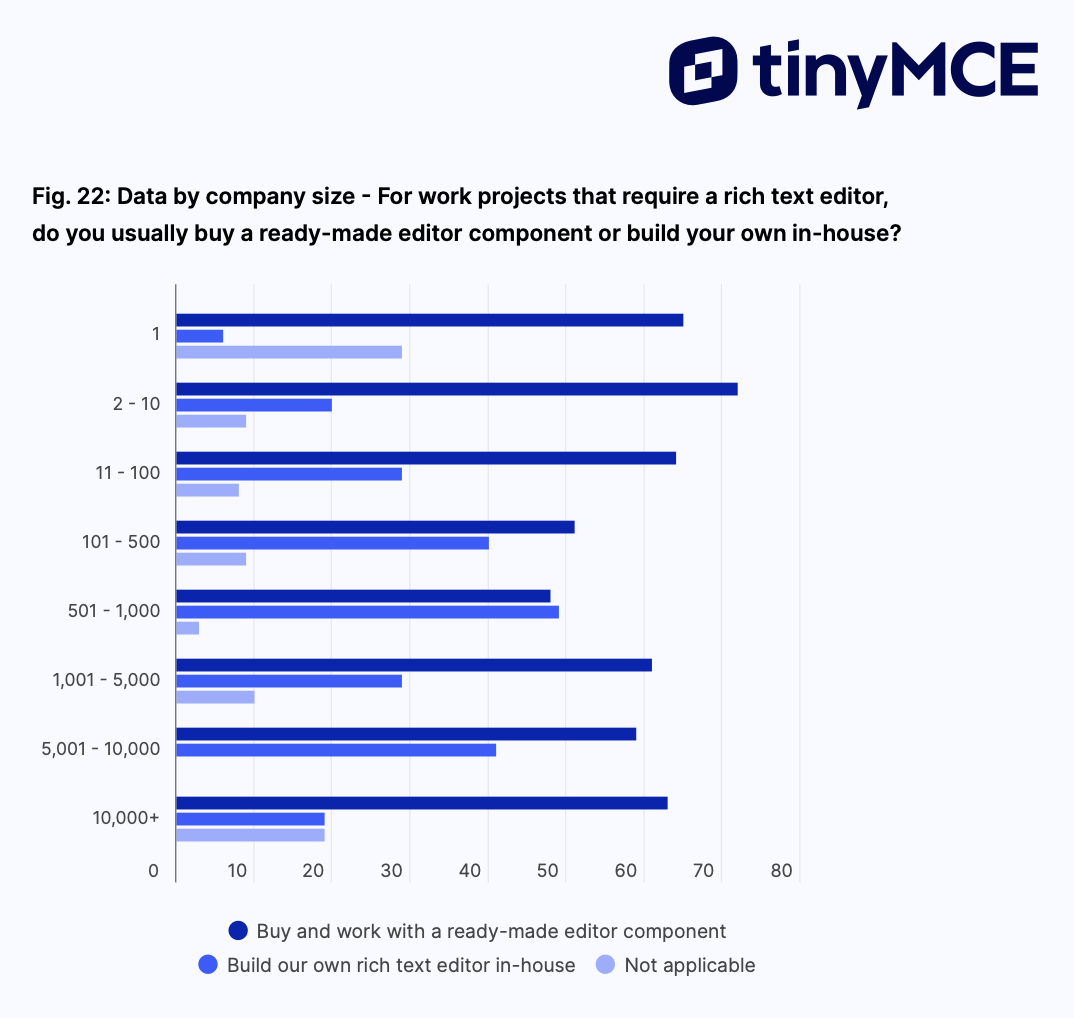
Data from the State of RTE Report 2025 reveals scale-driven behavior differences. Only 19% of organizations with more than 10,000 employees build their own editor. Mid-sized organizations (501–1,000 employees) build at nearly 50%.
Large enterprises have learned that owning commodity infrastructure doesn't scale, and the opportunity cost becomes difficult to justify. Mid-sized orgs absorb hidden long-term costs that can become visible years later when the editor has become legacy infrastructure that no one has time to fix.
Real-world patterns: OSS-heavy builds vs buying an OSS-based editor
The State of RTE Report 2025 also reveals the breakdown across organizations:
- 60% buy a third-party rich text editor.
- 30% build in-house.
Buying is the dominant pattern here, driven by practical experience with the alternatives. But buying doesn't mean accepting everything as-is.
Only 25% of teams use editors entirely out-of-the-box. Among companies using third-party editors, 30% still built custom plugins to extend specific functionality, and 32% used third-party plugins to add capabilities beyond the core offering.
When you build, customization means maintaining both the infrastructure and the features. If you adopt TinyMCE (whether self-hosted or via the cloud Free tier) customization means access to a library of over 25 open source plugins, or writing plugins against a stable API. With the cloud and commercial tiers, ongoing maintenance is TinyMCE’s responsibility. With self-hosted, you own updates and hosting, but you're still extending a maintained foundation rather than building one.
The effort of building a custom plugin for TinyMCE is measured in days or weeks. The effort of maintaining an entire editor while also building custom features is measured in quarters and years.
How to choose: Decision framework and scoring
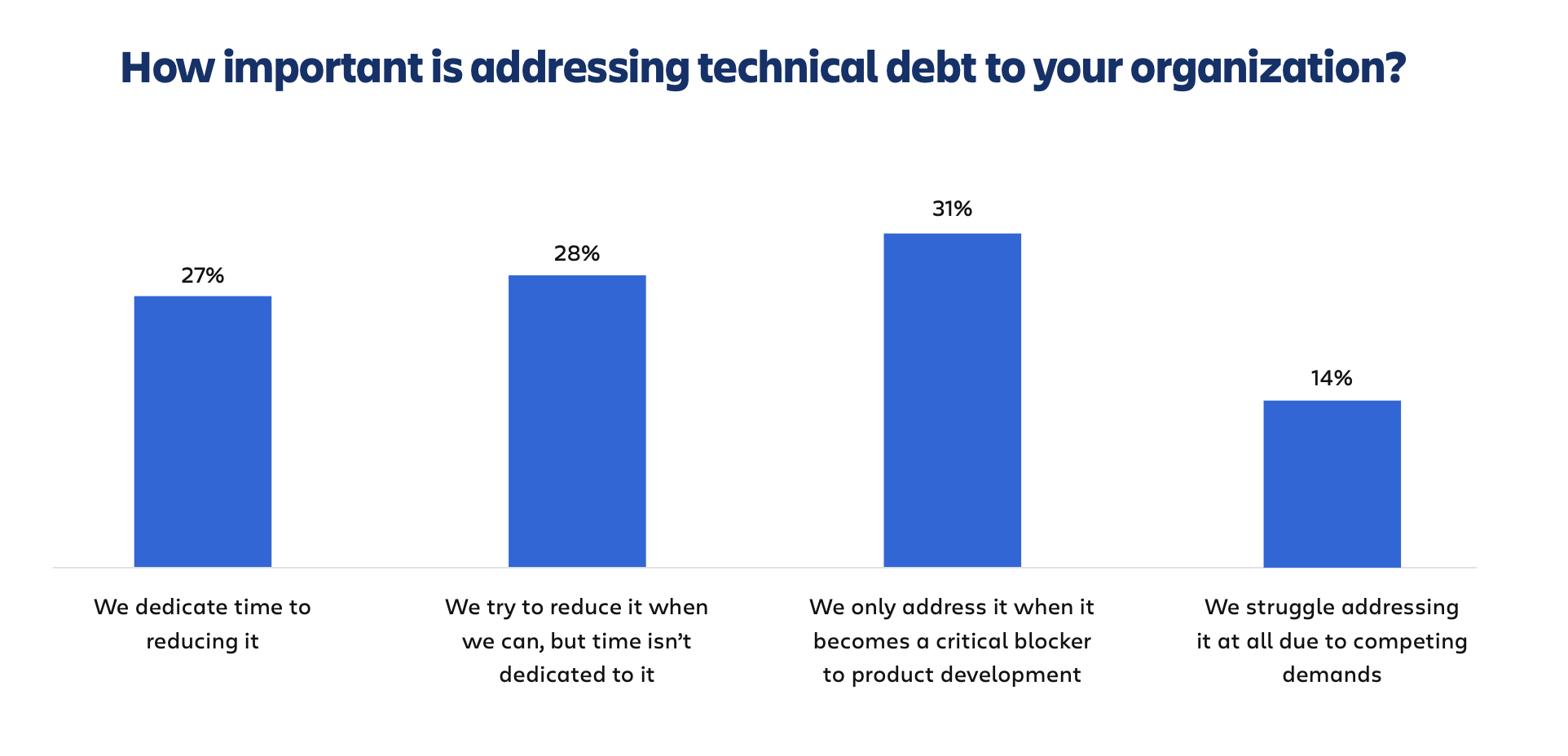
Planning the implementation, management, and maintenance of your RTE is critical if you don’t want to be part of these statistics from Atlassian’s State of Product Report 2026:
- 49% of product teams lack time for roadmap planning.
- 27% dedicate time to reducing technical debt.
- 80% of product teams don’t involve engineers early.
Most build-vs-buy failures don't stem from technical misjudgment; they stem from never making the trade-offs explicit. Articulate what your real requirements are, and create a long-term roadmap for your team so that you (and they) know what the next few years of editor ownership look like.
Useful evaluation criteria
Here are some criteria you can use to determine exactly what your team has time for, and what might be better to hand off to a vendor.
Strategic differentiation vs commodity capability: Is the editor how you win customers, or is it infrastructure that enables your actual value proposition? If your unique editing model is the product, building may be justified. If users only need to format text, insert images, and create tables the way they do everywhere else, you're just building commodity capability.
Customization depth required: Distinguish between feature-layer customization and infrastructure-layer customization. Do you need custom toolbar buttons, domain-specific content validators, or integration with your application's data model? That’s feature-layer customization, and it’s possible with features that are already available.
Do you need to rewrite how the editor handles IME input, manages collaborative state, or renders on mobile? That's infrastructure work, and it suggests either genuine technical uniqueness or overengineering.
Engineering capacity and tolerance for long-term maintenance: Can you allocate one engineer at 20% capacity for five years? Security patches coordinated across your entire stack? Accessibility compliance tracking? If you can't confidently allocate this capacity without impacting product roadmap execution, you don't have capacity for ownership, regardless of initial implementation feasibility.
Time-to-market pressure and delivery risk: Building adds variability and risk to your timeline. If your product launch depends on having a working editor by a fixed date, buying removes the editor from your critical path. If you have runway to absorb delays and cost overruns, then building becomes more viable, but only if the delays are acceptable trade-offs against your other priorities, and if they other risks associated with building are acceptable.
Decision scoring
A weighted scoring approach forces explicit trade-offs. Assign weights based on your organization's priorities:
- Strategic value of editor ownership (0-10): Is this your competitive moat?
- Customization requirements beyond plugins (0-10): Do you need infrastructure control?
- Available sustained engineering capacity (0-10): Can you staff this for years?
- Time-to-market flexibility (0-10): Can you absorb schedule risk?
If your total weighted score is below 25 out of 40, buying is likely the risk-adjusted path. If traffic volume and cost predictability matter to your decision, factor in which TinyMCE deployment model fits your needs: self-hosted, cloud Free tier, or commercial. Between 25-30, it's ambiguous and depends on organizational risk tolerance. Above 30, building may be justified, but verify that you're scoring honestly and not optimistically.
This framework doesn't guarantee success, but it surfaces the assumptions that teams later regret not examining.
Wrap-up: Choosing ownership deliberately
The technical question “Can my team build a rich text editor?” has a straightforward answer: yes. The strategic question is harder and more consequential: should you own this forever?
Building offers control. Control is only valuable if you can afford to exercise it continuously. Using the open source editor TinyMCE offers acceleration. Buying doesn't eliminate customization work; it shifts where that work happens.
The difference is that you're extending a maintained foundation rather than maintaining the foundation yourself. Sign up for the free 14 day trial from TinyMCE, which offers access to every premium feature available, and see for yourself if it meets your needs.


