


GDPR compliance is a shared responsibility between a rich text editor (RTE) as the data processor and you as the data controller. Ultimately, the framework of your partnership with the rich text editor determines how you meet these obligations, and the right editor can support your critical compliance efforts.
The editor is a GDPR compliance surface
Most teams scope GDPR at the database and the authentication layer, then forget the RTE. That is where the challenges begin. The rich text editor is the place where personal data and free-text content enter your product, get formatted, get transmitted, and get logged. It quietly captures names, email addresses, support case notes, customer messages, and images carrying EXIF metadata. None of that was collected on purpose, which is exactly why it tends to fall outside the data map.
The editor is also third-party code running inside your trust boundary. It often calls services you don’t own, like a cloud distribution network, an image proxy, a spellchecker, or an AI API. Every one of those calls is a data flow a regulator can ask you to account for, and every one is a question an enterprise security reviewer will raise before they sign. GDPR fines reach twenty million euros or four percent of global turnover, but the cost that lands first is usually quieter than a fine. It is the deal that stalls in procurement because nobody is tracking where the editor content actually goes.
Where personal data flows in the editing layer
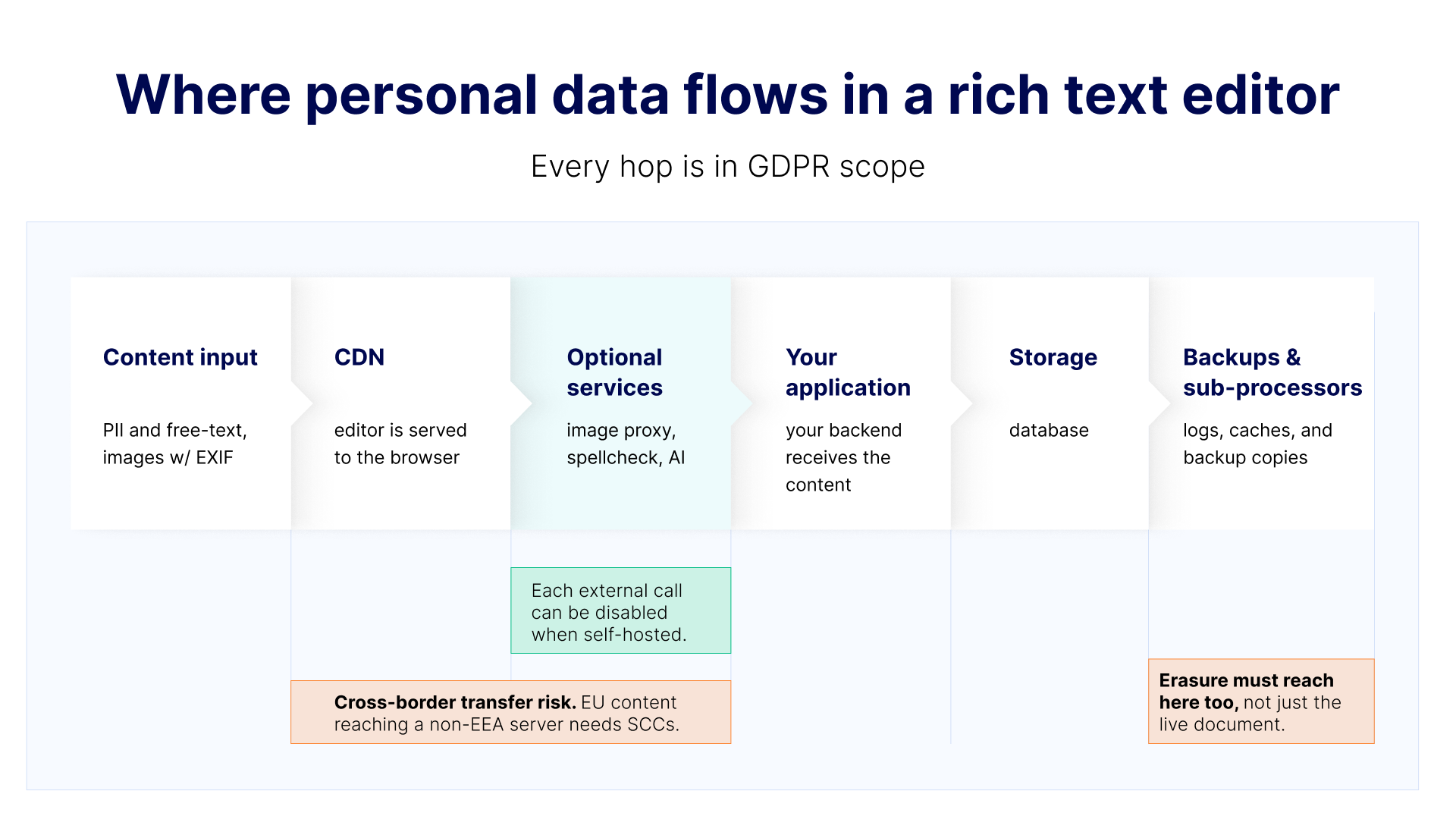
Before you can pick a GDPR-supporting RTE, you have to trace what happens to content after a user types it. The path runs from content input, through any cloud distribution or CDN, into optional services like image upload, link handling, spellcheck, or AI, then back to your application, into storage, and finally into backups and any sub-processors. Each hop is a place data lives, and each one is in scope.
The controller and processor split
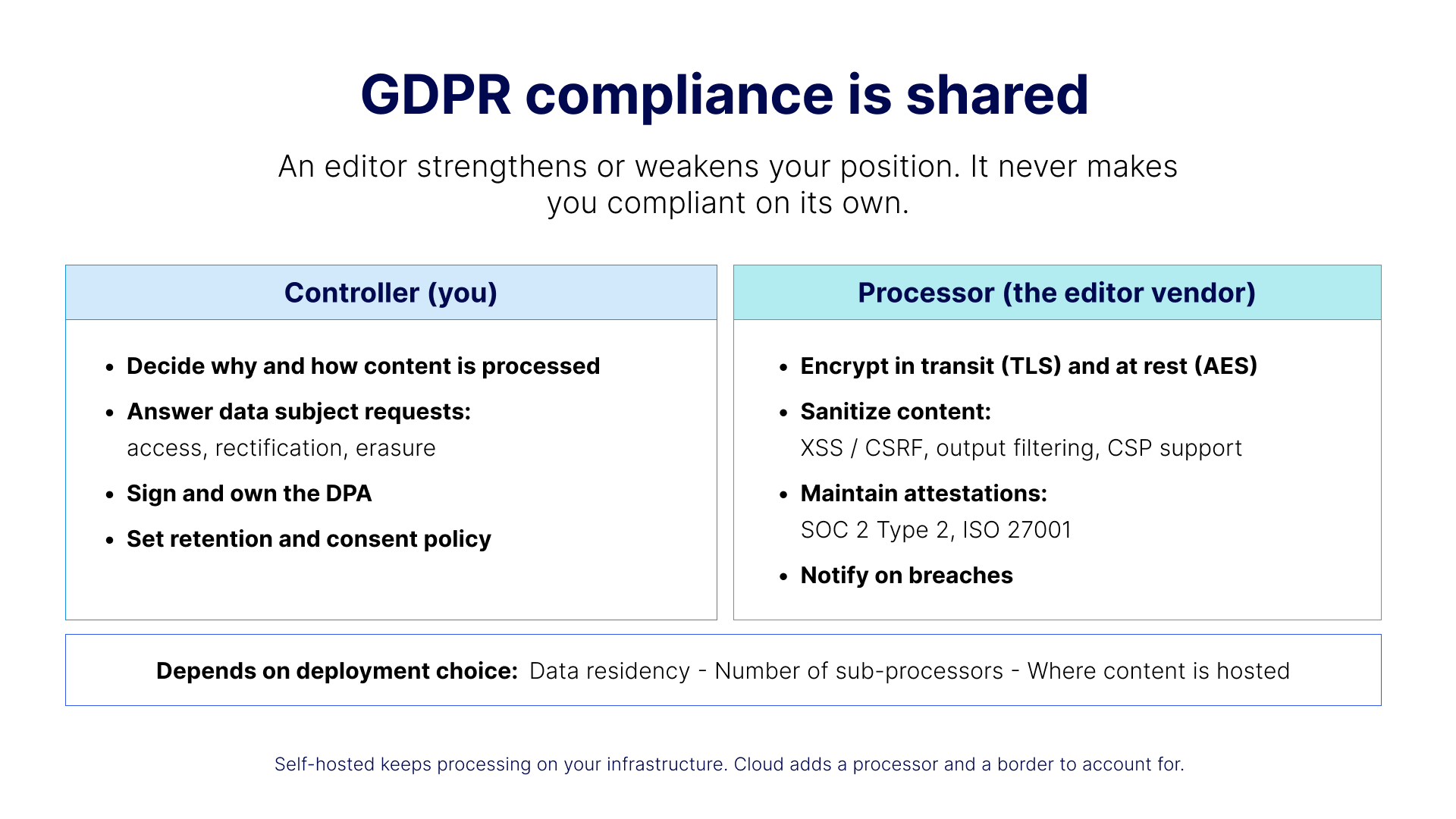
You decide why and how content is processed, which makes you the controller. The editor vendor processes content on your instructions, which makes them a processor. That distinction decides who answers a data subject access request and who signs the Data Processing Agreement (DPA). Get it backwards and the audit trail will not hold up, because you won’t be able to show who was responsible for what.
Data residency and cross-border transfers
EU content that leaves the European Economic Area needs a lawful transfer mechanism, usually Standard Contractual Clauses written into the vendor agreement. A US-hosted cloud editor moves data across a border the moment it loads in a European user's browser. That happens whether or not anyone intended it, and it is squarely in scope. Self-hosting is the cleanest answer to residency, because content stays on infrastructure you control, and never reaches a server the vendor operates.
Deletion that reaches the backups
"The right to be forgotten" under GDPR mandates that deleting content from a live document isn’t sufficient to meet compliance requirements. To achieve true erasure, personal data must also be removed from all auxiliary locations where it has been stored, including:
- Logs and Caches: Temporary data stores that often retain information.
- CDN Copies: Content distributed through content delivery networks.
- Backups: Long-term storage of data snapshots.
Deletion that misses any of those is not erasure, and it is one of the most common ways a well-intentioned integration fails an audit. When you evaluate an editor, ask where content is cached and copied, then ask how each of those copies gets removed when it’s necessary to erase personal data.
What you actually need: A GDPR evaluation checklist
The honest way to compare editors is to set your criteria before you look at any product. These are the things that matter when content is personal data, and they map directly to the questions a security reviewer will ask you.
- Deployment model: Cloud, EU data residency, and self-hosted or on-premise options. This is your primary residency lever.
- Cross-border transfer mechanism: Standard Contractual Clauses and a documented sub-processor list.
- A current third-party attestation: SOC 2 Type II or ISO 27001. "We take security seriously" is not an attestation.
- A signable DPA with a clear controller and processor definition.
- Encryption stated plainly: TLS in transit and AES at rest.
Beyond those five, look at how the editor handles content and external calls:
- Content sanitization should cover cross-site scripting and request forgery, with output filtering, Content Security Policy support, and a configurable HTML schema.
- Check whether the editor or its plugins set cookies you would have to disclose and gather consent for.
- Confirm that external service calls, including AI and image proxy features, are disclosed and that each one can be disabled to fit your risk profile.
- Confirm you can fulfill access, rectification, and erasure requests, that deletion reaches your backups, and that versioning gives you a tamper-resistant record of who changed what.
- Accessibility under WCAG and the European Accessibility Act sits next to GDPR rather than inside it, but it is increasingly part of the same procurement gate, so it belongs on the list.
How four rich text editors meet GDPR criteria in 2026
The table below maps each editor against those criteria. Where a cell reads "claimed" or "self-host control," that reflects either a shorter track record or the fact that self-hosting moves the responsibility onto you.
|
Criterion |
TinyMCE |
CKEditor 5 |
Eddyter |
Tiptap |
|
Deployment |
Cloud + self-hosted |
Cloud + self-hosted |
Cloud + residency |
Cloud + self-hosted |
|
SCCs / sub-processors |
Yes (cloud) |
Yes (cloud) |
Claimed |
Yes (cloud) |
|
Attestation |
SOC 2 Type II |
SOC 2 Type II |
GDPR + SOC 2 Type II on the roadmap |
SOC 2 Type II |
|
Signable DPA |
Yes |
Yes |
Claimed |
Yes |
|
Encryption |
TLS + AES |
TLS + AES |
Claimed |
TLS + AES |
|
Sanitization / CSP |
Output filtering, CSP, SVG off by design |
Filtering, configurable schema, CSP |
Claimed |
Bring your own |
|
Cookies in editor |
None |
Per config |
Unverified |
None |
|
External calls disableable |
Yes (CORS + JWT self-host) |
Configurable |
Unclear |
Configurable |
|
DSAR support |
Via support; breach protocols |
Supported |
Claimed |
Supported |
TinyMCE
TinyMCE gives a SaaS team the strongest position when you want deployment choice without giving up a third-party attestation:
- The cloud offering is served through an AWS CloudFront distribution and Cloud Services designed for GDPR, with access restricted by API key (or license key) and Allowed Domains.
- The editor, its premium plugins, server-side components, and Tiny Drive do not use cookies, which removes a consent burden many teams don’t realize they have.
- Self-hosting is where the residency story gets clean: Data processed on self-hosted components is not sent to any server Tiny controls, each external service call can be disabled, and access is restricted through configurable CORS origins plus JWT where it applies.
TinyMCE is still a processor rather than a guarantee, and the controller still owns the policy, but it is the balanced choice for teams that need flexibility and attestation together.
CKEditor
CKEditor 5 fits enterprises that need real-time collaboration and on-premise control at the same time. It carries SOC 2 Type II, offers a configurable HTML schema, and works inside strict Content Security Policy environments. The trade-off to name plainly is that its collaboration backend is its own data flow, so you account for that surface in addition to the editor itself.
Tiptap
Tiptap comes in two shapes, and they sit in different places on this table. The open-source editor is a headless framework you host yourself. It gives you total control and hands you every responsibility that goes with it: sanitization, the DPA, DSAR plumbing, and the attestation.
Tiptap also runs a managed Cloud Platform, and that product carries its own posture. It is SOC 2 Type II, GDPR compliant with a signable DPA, offers EU-only hosting for residency, encrypts data with AES-256 at rest and TLS in transit, keeps backups with point-in-time recovery, publishes a sub-processor list, and runs regular third-party penetration tests. So the answer depends on which one you deploy.
Self-host the editor and the surface is yours end-to-end, with more compliance work to do. Use the Cloud Platform and Tiptap takes on the processor role much like the other vendors here.
Eddyter
Eddyter makes the right claims, listing SOC 2, GDPR, HIPAA, and data residency, but it has a shorter track record than the others, so treat its attestations as something to verify directly before you commit.
Wrap up: The bottom line
The editor should fit your compliance posture, not the other way around. The decision is not which editor wears a compliance badge. It is which one lets you show an auditor and a buyer exactly where your users' content lives, and gives you the deployment model and the paperwork to back that answer up. Pick the editor whose model matches the answer you need to give.
If your users are in the EU and you want to walk through the self-hosted external-service list, how AI features route content, and what data residency looks like for your integration, talk to the TinyMCE team about your specific setup.
FAQ
Which rich text editors are GDPR compliant in 2026?
TinyMCE and CKEditor 5 are among the strongest options when it comes to GDPR readiness, but no editor is GDPR compliant on its own, because compliance is shared between you as the data controller and the editor provider as the data processor. The editors that put you in the strongest position combine flexible deployment options that let you keep data where you need it, together with a current third-party security attestation and a signable Data Processing Agreement (DPA). Both TinyMCE and CKEditor 5 stand out by offering strong deployment flexibility, established GDPR support, SOC 2 Type II attestation, and enterprise-ready compliance documentation, making them reliable choices for organizations with strict privacy and regulatory requirements.
Do I need a data processing agreement (DPA) with my rich text editor vendor?
If the editor or its hosted services process personal data on your behalf, then yes. A DPA is the contract that defines the split, naming you as the controller and the vendor as the processor, and setting out what the vendor can do with the content and on whose instructions. Without one, you can’t show an auditor who was responsible for what. The exception is a fully self-hosted deployment that never sends content to the vendor, where the question largely falls away.
Do third-party plugins change my GDPR exposure?
Yes. Every plugin is a potential new data flow and a potential new sub-processor. Vet what each plugin calls, prefer a vetted ecosystem, and confirm that any external call can be disabled. With a headless framework, this responsibility sits entirely with you.
Does the size of my organization change the requirements?
The editor criteria do not change, but the paperwork around them scales. Larger organizations face Data Protection Impact Assessments, a Data Protection Officer, and heavier vendor due diligence. Smaller teams still owe a signed DPA and the ability to fulfill data subject requests.
Is cloud or self-hosted the safer choice for European customers?
Neither is inherently more compliant. Self-hosting gives you the tightest residency control and the fewest sub-processors, at the cost of operational burden. Cloud offloads that work but adds a processor and a border to account for through Standard Contractual Clauses.


