


Rich text editors are supposed to integrate into your application easily and look like part of your app. But many teams discover post-implementation that an editor that promised flexibility has become a customization bottleneck. How can you find an RTE that actually meets your customization needs without creating technical debt?
WYSIWYG editor customizability is critical
The numbers are clear: the rich text editor must be customizable and allow a large measure of control over how it fits into an app. Seventy-one percent of professionals who work with and develop web apps rated customizability as extremely or very important, making it a non-negotiable for WYSIWYG editors. Additionally, 29% of respondents cited "is highly customizable, gives me full control of the experience" as a key decision driver.
This holds true across all company sizes, with 65-72% rating it as extremely or very important regardless of organization size.
Defining metrics for customizability
Customizability is often measured using a five point framework rooted in the Component Based Software Engineering standards (CBSE) and the Extensibility Metric for Software Architecture (EMSA) to measure whether an editor will accelerate or impede your product roadmap.
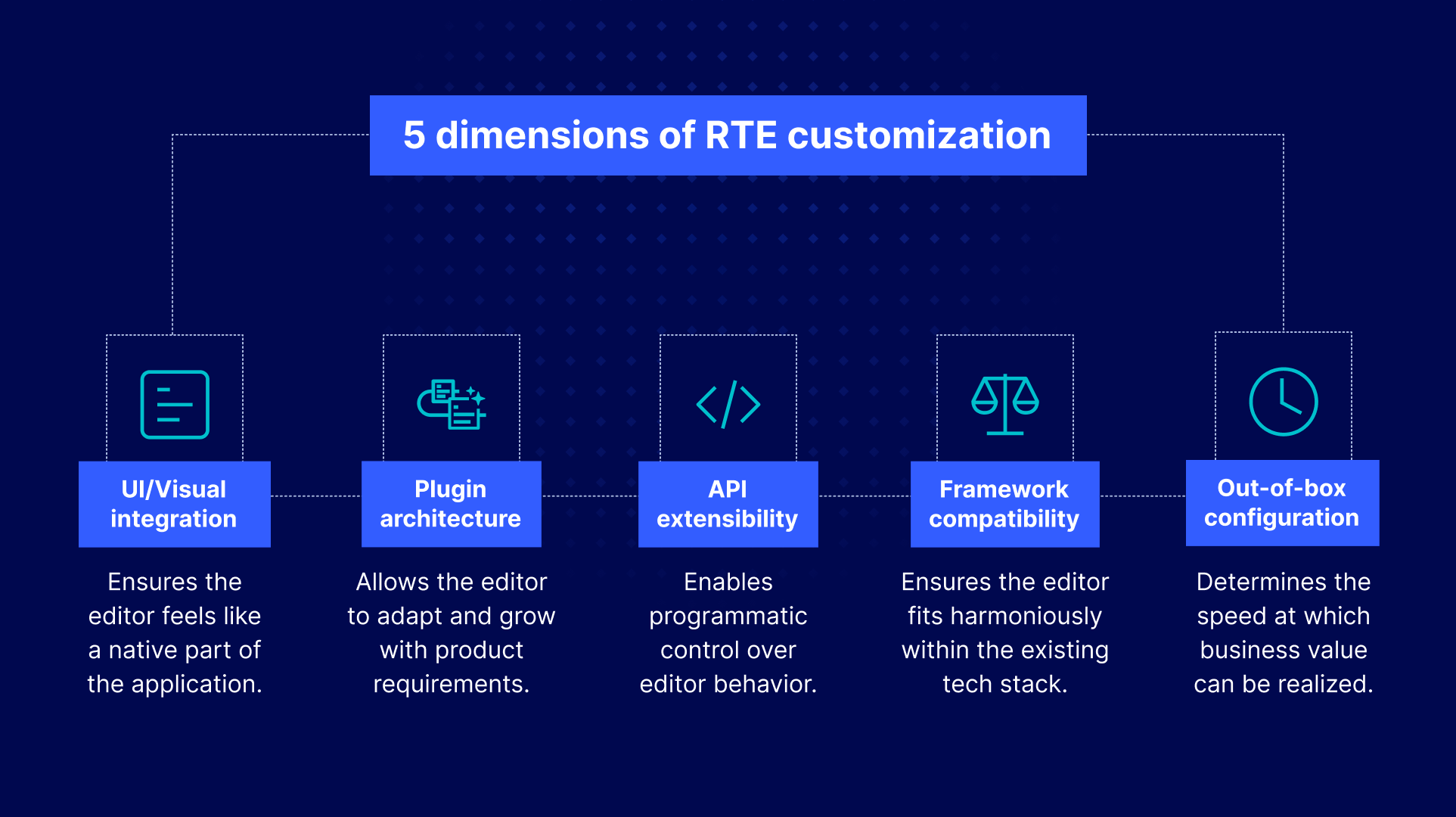
Dimensions to measure WYSIWYG editor customizability
- UI/Visual integration: Measures if the editor UI and UX feels native or foreign in your application.
- Plugin architecture: Measures whether you can extend functionality or create a custom plugin versus being locked into a plugin system.
- API extensibility: Measures whether you can alter the API calls to work naturally with your back end.
- Framework compatibility: Measures how the editor integrates smoothly or becomes an architectural liability.
- Out-of-box configuration: Measures immediate customization against long-term flexibility.
Measure these dimensions properly, and your editor can become invisible infrastructure that scales with your needs. Measure them improperly, and you're either locked into vendor constraints or drowning in technical debt from custom workarounds.
Using the five dimensions to measure WYSIWYG editor customizability
Each of the five dimensions for measuring rich text editor customizability has real-world, intentional purpose behind it.
Criteria #1: UI/Visual integration
UI/Visual integration determines whether a rich text editor can become an invisible, native-feeling component of your application rather than an obviously third-party element. Users should perceive the editor as an inherent part of your app interface. Poor UI/Visual integration creates high coupling between objects (CBO) and increases complexity, leading to technical debt and ongoing maintenance.
The data from the State of RTE Report 2025 backs this up: 40% of teams customize the UI to fit their application, and only 25% use the editor out-of-the-box with no customization. Even the most extensible API or comprehensive plugin architecture can result in a poor UI/UX experience that undermines user trust and increases support costs.
UI/visual integration reduces the total cost of ownership (TCO) by ensuring the editor integrates so naturally that it allows your team to focus on building features rather than fighting customization.
Criteria #2: Plugin architecture
Plugin architecture determines whether your RTE can evolve with your product's requirements over time. You need an editor that can start simple but grow as sophisticated business demands evolve without forcing costly migrations or rewrites.
A well-designed plugin system keeps the editor core stable while specialized features (collaboration, accessibility, custom content blocks, AI assistance) can be added, removed, or replaced independently. Nearly two-thirds of organizations extend their editors beyond out-of-the-box capabilities: 32% implement third-party plugins, and 30% develop custom plugins (State of RTE Report 2025).
Modularity reduces maintenance complexity; plugins operate through well-defined interfaces rather than requiring modifications to core code. Leading editors like TinyMCE, CKEditor, and ProseMirror demonstrate this through large plugin ecosystems. A modular plugin system allows you to keep your TCO low while preserving the flexibility to adapt.
Criteria #3: API extensibility
API extensibility determines whether your development team can programmatically orchestrate the editor's behavior to match your application's unique workflows, rather than being limited to pre-built UI controls alone.
A well-designed API allows developers to programmatically access content models, selection states, formatting operations, and lifecycle events without modifying the editor's core code. According to the State of RTE Report, 28% of developers interface directly with the editor API in headless mode, highlighting the demand for deep programmatic integration beyond traditional UI-based editing.
TinyMCE and CKEditor provide granular access to content, changes and events through APIs that work consistently, allowing developers to build custom behaviors that integrate with backend systems or enforce business-specific content policies. A powerful API transforms the editor from a generic text input into a domain-specific content creation tool.
Criteria #4: Framework compatibility
Framework compatibility determines whether an RTE can become a native component within your existing tech stack rather than an architectural outlier. The editor needs to work cleanly with your chosen framework (such as React, Vue, Angular, Blazor, or jQuery) while also working reliably across the browser compatibility matrix (Chrome, Safari, Firefox, Edge…).
Poor framework compatibility creates coupling issues: editors that maintain their own state outside the framework force developers to build complex synchronization layers. The State of RTE Report 2025 shows that 65% of technical professionals rate framework integration as extremely or very important.
Architectural alignment is non-negotiable for modern development teams. Your RTE should ensure consistent behaviour without compatibility issues across different frontend frameworks.
Criteria #5: Out-of-box configuration
Out-of-the-box configuration determines whether your team can extract business value from the editor immediately or must invest weeks or months in configuration work before deployment.
This fundamental tension between immediate productivity and long-term flexibility usually means that you need an editor that provides intelligent defaults for common use cases (formatting toolbar, paste handling, content validation) while also exposing configuration options for specialized requirements, all without requiring custom code or extensive setup time.
While 25% of professionals use the editor out-of-the-box with no customization, the remaining 75% engage in varying degrees of customization, from UI adjustments (40%) to custom plugin development (30%), showing that thoughtful defaults don't preclude deeper customization when needed (State of RTE Report 2025).
Leading editors balance strong defaults with customization flexibility. The right balance allows you to deploy quickly with proven defaults, then refine settings, which reduces TCO without creating technical debt.
Wrap up: How the top four editors compare
In part two of this series, you’ll learn how customizing TinyMCE, CKEditor, Tiptap, and Froala compare against each other within these five dimensions. It also shares an evaluation framework that you can use to measure the level of customization that you need from your WYSIWYG editor, an which editor may suit your project requirements. In the meantime, learn more about how long it takes to customize TinyMCE, or ask our DevRel Manager Fred Harper any questions you have.


